
Updated: Aug 5
By Dr. Joel Ramsey, The Paranormal Professor
In 1861, a Boston engraver named William Mumler developed a photographic plate in his own studio and found that he was not alone in the picture. Standing beside him was a faint, translucent young woman. He claimed he did not recognize her and could not explain how she had appeared. When he showed the image to friends, one of them identified her as Mumler's cousin, who had been dead for years.
Within months, grieving families were traveling across the country to sit for his camera.
Whether Mumler was lying is a question I will come back to. What interests me more, and what has interested me through years of examining photographs that people believe contain the dead, is why so many people needed him to be telling the truth.
In the history of paranormal investigation, photography has often been treated as definitive proof. A shadowy figure in the corner of a frame, a translucent form hovering behind a living person, an unexplained orb of light floating through a room. These images have convinced millions of people that they've captured evidence of the afterlife. Yet many of the most famous "ghost images" from the 19th and early 20th centuries reveal more about human perception, photographic technology, and outright fraud than they do about spirits of the dead.
Since the dawn of photography in the 1830s, people have been trying to capture proof of the afterlife. And for just as long, some photographers have been exploiting that desire for profit, comfort, or fame.
As a paranormal investigator with a background in communication theory, I approach allegedly paranormal photographs the same way I approach any claimed evidence: with rigorous skepticism, systematic analysis, and an understanding of how human perception and cultural narratives shape what we believe we're seeing. Throughout this article you'll notice that I keep returning to the same handful of questions, the ones I ask whenever someone hands me a photograph and asks me what it is. Those questions eventually became the Ramsey Communication-Based Investigation Protocol, and I'll lay the protocol out in full later on.
But before we go back to the nineteenth century, let me start with a photograph that was handed to me after a lecture.
The Shadow Figures That Were Glass Reflections
I've personally debunked numerous allegedly paranormal photographs over my years as an investigator, and the most instructive case involved a gentleman who approached me after one of my keynote addresses. He showed me a photograph he'd taken of a historic photograph displayed at the venue. The historic image showed a Victorian-era family, and behind each person in the photograph, dark, shadowy shapes appeared to cling to them. He believed he'd captured evidence of "shadow attachments," spirits clinging to the family members.
I examined the image carefully. The shadows had a soft, diffused quality consistent with light refraction. I suspected the historic photograph was displayed under glass, and that what he'd captured were reflections and light distortions caused by the glass, his camera angle, and the lighting in the room.
Rather than simply tell him this, I asked him to return to the location, examine the photograph in person, and test whether moving his viewing angle changed the shadows. He did, and he discovered I was correct. The photograph was under glass. The shadows shifted and changed as he moved around the room. They were reflections, not spirits.
I've written about this case at length in another post, The Glass and the Ghost: When Compassion Meets Critical Thinking in Paranormal Investigation, and I'll return to the second photograph he showed me later in this article, because that one I chose not to debunk at all. For now, the case illustrates the central point: what appears to be paranormal is usually an interaction between light, glass, camera position, and human pattern recognition.
That interaction is not new. It is as old as the medium itself.
The Birth of Spirit Photography: William Mumler and the Grieving Nation
Mumler was the first known spirit photographer, and he stumbled into the business almost by accident with that 1861 self-portrait. Word of the image spread quickly, and Mumler, recognizing a business opportunity, began advertising his services. For a fee, grieving clients could sit for a portrait and, when the photograph was developed, see their deceased loved ones appearing beside them.
The timing was perfect. The American Civil War had just begun, and within four years more than six hundred thousand Americans would be dead. Families were desperate for any connection to loved ones lost in battle, and Mumler offered them exactly that: photographic "proof" that the dead were still with them. His business exploded, and clients traveled from across the country to have their portraits taken with the spirits of husbands, sons, fathers, and brothers who had died in the war.
How did he do it? Mumler used a technique called double exposure. He would photograph a living person, often dressed in flowing white fabric or gauze to create a ghostly appearance, on a glass plate negative. Then, without fully developing or clearing that plate, he would photograph his paying client on the same plate. When the final image was developed, the two exposures would be superimposed, creating the illusion of a translucent spirit hovering beside the living person. Because photographic processes were mysterious to most people in the 1860s, clients had no reason to suspect trickery. They saw their loved ones in the photograph, and that was proof enough.
The fraud trial. Mumler's success attracted imitators, and it also attracted suspicion. In 1869 he was arrested and tried for fraud in New York City, where the prosecution argued that he was exploiting grieving families with photographic tricks. The trial became a media sensation. Prominent spiritualists testified in Mumler's defense, arguing that the photographs were genuine spirit communications, while skeptics, including photographers who demonstrated how double exposures could be created, testified for the prosecution.
Mumler was ultimately acquitted, not because the court believed his photographs were genuine, but because the prosecution couldn't definitively prove fraud under the existing laws. The trial damaged his reputation, his business declined, and he died in poverty in 1884. Yet spirit photography didn't die with him, and understanding why requires understanding the culture that wanted it.
The Victorian Obsession with Death and Photography
The 19th century was a time when death was ever-present. Infant mortality was high, diseases like tuberculosis, cholera, and pneumonia killed people of all ages without warning, medical science had few answers, and grief was a constant companion for most families.
Photography, invented in the 1830s, arrived at exactly the moment when people desperately wanted to preserve memories of those who had died. Post-mortem photography became common practice, and families would photograph their deceased loved ones, often posed as if sleeping or, in the case of children, held by living family members. These photographs served as the only visual record many families had of their dead.
Spirit photography took this practice one step further. Instead of photographing the dead body, spirit photographers claimed to capture the dead person's spirit visiting the living. This offered something post-mortem photography couldn't: the suggestion that death wasn't the end, that consciousness persisted, that the dead could return to comfort those they'd left behind.
This wasn't just about grief. It was about meaning. Victorian society was grappling with rapid industrialization, scientific advances that challenged religious certainties, and social upheaval, and spirit photography offered reassurance that there was something beyond the material world, something science couldn't measure or explain. People wanted to believe, and a growing trade of photographers was ready to give them reasons to.
The Techniques of Spirit Photography: How They Created Ghosts
Spirit photographers employed several techniques to create their ghostly images, and understanding these methods is essential for modern investigators analyzing allegedly paranormal photographs, because nearly every one of them has a digital descendant.
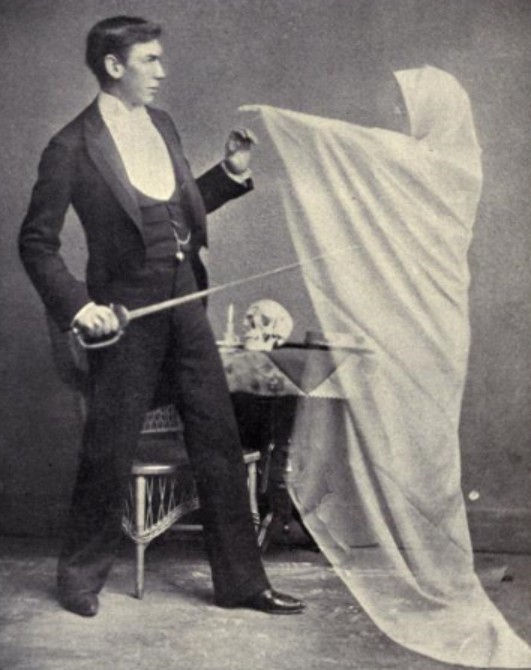
Double exposure. This was the most common technique. The photographer would take two separate exposures on a single photographic plate. The first exposure might be a person dressed in white or draped in gauze, photographed against a dark background, and the second exposure would be the paying client. When developed, the two images would be superimposed, with the first figure appearing translucent and ghostly. Skilled photographers could control the opacity of the "spirit" by varying the exposure times, creating figures that ranged from barely visible to almost solid.
Long exposure. Early photographic processes required long exposure times, sometimes several seconds or even minutes. During a long exposure, a person could walk into the frame, remain still for a brief moment, and then walk out of the frame before the exposure ended. The result would be a semi-transparent figure that appeared to be floating or hovering, and the technique worked particularly well for creating the illusion of spirits manifesting during the session.
Prepared plates and pre-exposed negatives. Some photographers would pre-expose a glass plate negative with an image of a "spirit" figure, then use that same plate to photograph their client. The client had no way of knowing the plate had been previously exposed, so when the final image was developed, the spirit appeared to have materialized during the sitting.
Mirror and glass reflections. More sophisticated spirit photographers used mirrors, angled glass, or other reflective surfaces positioned outside the camera's direct view. An assistant, dressed in white or ghostly attire, would stand in a position where they'd be reflected in the mirror or glass, but appear in the photograph as a translucent figure behind or beside the client. If that sounds familiar, it should. It is the deliberate version of what happened by accident to the gentleman at my keynote.
Theatrical gauze and muslin. Photographers discovered that lightweight fabrics like muslin or gauze, when photographed against dark backgrounds with careful lighting, created ethereal, flowing forms that looked distinctly otherworldly. Combined with double exposure or long exposure techniques, these fabrics became the "ectoplasm" of Victorian spirit photography.
William Hope, the Crewe Circle, and the Marked Plates
Spirit photography persisted well into the 20th century, and one of the most famous practitioners was William Hope, who operated in Crewe, England, from around 1905 into the 1920s. Hope and his associates, known as the Crewe Circle, produced hundreds of spirit photographs for grieving clients, and like Mumler before him, Hope's business boomed during and after the First World War, when millions of families were mourning sons, husbands, and fathers lost in the trenches. His photographs showed spirits appearing behind clients, sometimes clearly recognizable as deceased relatives, other times as vague, ectoplasmic forms, and he was endorsed by significant public figures, including the chemist William Crookes and Sir Arthur Conan Doyle.
Hope's exposure came on February 4, 1922, at the British College of Psychic Science in London, and it came from Harry Price, a psychical researcher working on behalf of the Society for Psychical Research. Price secretly marked the photographic plates he supplied for the sitting, and he included plates that had been covertly etched with the manufacturer's trademark, so that the mark would necessarily appear on any plate Hope genuinely used. When the developed photographs showed spirit "extras" but did not carry Price's marks, Price concluded that Hope had swapped the supplied plates for ones prepared in advance.
Harry Houdini belongs in this history as well, though not in this particular sitting. Houdini's investigations were motivated by personal grief, since his beloved mother had died and he desperately wanted to believe communication with the dead was possible. As he investigated mediums and spirit photographers through the 1920s, he found fraud at nearly every turn, and he demonstrated publicly and repeatedly how the effects were produced.
What happened next is the part investigators should sit with. Conan Doyle refused to accept the evidence against Hope, defended him in print, and led a wave of resignations from the Society for Psychical Research. A decade later, Fred Barlow, once a friend and supporter of Hope's work, reviewed the material and also concluded the photographs were fraudulent. Hope kept his believers regardless. Exposure, it turns out, does not reliably end belief, and any investigator who assumes that a good explanation will be received as good news is going to be disappointed.
Modern Ghost Photography: Digital Deception and Honest Mistakes
Spirit photography declined as photographic technology advanced and became more widely understood. By the mid-20th century, most people knew that photographs could be manipulated, that double exposures could be created, and that what appeared in a photograph wasn't necessarily real. But ghost photography didn't disappear. It evolved.
With the advent of digital cameras, smartphones, and photo-sharing on social media, allegedly paranormal photographs have exploded in popularity, and while deliberate fraud still exists, most modern "ghost photos" result from honest misunderstanding of how cameras and digital imaging work.
Orbs, the digital ghost. The most common modern ghost photo is the orb, a circular, often translucent ball of light appearing in photographs, usually in low-light conditions with flash photography. Paranormal investigators in the 1990s and 2000s popularized the theory that orbs represented spirit energy, and television shows featured investigators capturing orbs on camera and declaring them evidence of paranormal activity. The reality is that orbs are almost always dust, moisture, or insects illuminated by the camera's flash. When you take a flash photograph, the flash creates a cone of light extending from the camera, and any particle in that cone reflects the light directly back into the lens. Because the particle is very close to the lens and out of focus, it appears as a soft, circular blob of light. Digital cameras, with their small sensors and close proximity between lens and flash, are particularly prone to creating orbs, and the phenomenon is so well understood that legitimate paranormal investigators no longer consider orbs evidence of anything except dusty environments.
Lens flares and light artifacts. When bright light sources such as the sun, streetlights, or indoor lighting hit a camera lens at certain angles, they create lens flares, streaks, or spots of light that appear in the photograph but weren't visible to the naked eye. Digital cameras can also create light artifacts due to internal reflections within the lens assembly, and these artifacts can look like rods, streaks, or geometric shapes that people misinterpret as paranormal phenomena.
Motion blur and long exposures. Smartphone cameras, especially in low-light conditions, automatically increase exposure time to capture enough light. If the camera moves during this longer exposure, or if something in the frame moves, it creates motion blur, streaks, or semi-transparent figures. People photograph what they think is an empty hallway, but a person walking quickly through the frame during the exposure creates a ghostly, transparent figure. This is the modern equivalent of the Victorian long exposure trick, except it's happening accidentally rather than deliberately.
Compression artifacts and digital noise. Digital photographs, especially those taken in low light or compressed for social media sharing, can develop compression artifacts, blocky distortions, or noise patterns that some people interpret as faces, figures, or anomalies. Our brains are wired to recognize faces and patterns, a phenomenon called pareidolia, and when we see random digital noise, our pattern-seeking brains sometimes construct faces or figures out of the randomness. That same tendency explains a great deal about how ordinary rooms come to feel occupied, which I've written about in Why Every New Home Feels a Little Haunted.
Camera strap ghosts. One of the most common and easily debunked modern ghost photos is the camera strap ghost. When taking a photo, especially a selfie, the camera strap hangs in front of the lens, and the strap, being very close to the lens and out of focus, appears as a semi-transparent, curved shape. People see this and think they've captured ectoplasm or a ghostly form.
It's a camera strap.
Applying RCIP to Photograph Analysis
When someone presents me with an allegedly paranormal photograph, I apply the same systematic approach I use for all claimed evidence. I've described the protocol and the reasoning behind it in more detail in Speaking Paranormal, Part Two: The Tools of Responsible Investigation, but here is how the five phases work when the evidence is an image.
Phase 1: Pseudocognition assessment. What does the person already believe about the photograph? Did they take the photo expecting to capture something paranormal? Were they in a location with a haunted reputation? What paranormal media have they consumed that might shape their interpretation? Understanding their expectations helps me assess how confirmation bias might be influencing what they think they're seeing.
Phase 2: Environmental baseline. What are the mundane explanations? Could this be an orb caused by dust or moisture, a lens flare from a light source, motion blur from camera shake or a moving subject, a reflection in glass or a mirror, a digital compression artifact, or a camera strap? I systematically rule out every natural explanation before considering paranormal possibilities.
Phase 3: Communication network analysis. How did the photograph spread? Who first identified the ghost in the image? Did others independently see the same figure, or did the first person's interpretation shape what everyone else saw? This reveals whether we're dealing with a genuine visual anomaly or the social reinforcement of pareidolia, and it is the phase most investigators skip entirely.
Phase 4: Controlled investigation. Can the photograph be replicated? If the person returns to the same location under similar conditions, do they capture the same anomaly? Can the effect be recreated by adjusting camera settings, lighting, or positioning? If the phenomenon can't be replicated, it's likely a one-time artifact of specific conditions rather than evidence of a persistent paranormal presence.
Phase 5: Data triangulation. Does the photograph correlate with other evidence? Were there EMF spikes, temperature changes, or auditory phenomena captured at the same time and location? Or is the photo the only piece of claimed evidence? Standalone photographic evidence is seldom sufficient to support paranormal claims.
The Ethics of Debunking Ghost Photos
Here's what I've learned from years of analyzing allegedly paranormal photographs: people don't just want proof of ghosts. They want meaning. When someone shows me a photograph they believe contains their deceased grandmother's spirit, they're not just asking me to validate their photographic evidence. They're asking me to validate their grief, their hope that death isn't the end, their need for connection with someone they've lost. I take that seriously.
But I also have a responsibility to the truth, and the truth is that the vast majority of allegedly paranormal photographs have mundane explanations. My approach is to educate, not humiliate. I show people how orbs are created, I demonstrate lens flares, I explain pareidolia, and I teach them to think critically about photographic evidence. Most people appreciate this, because they'd rather understand what they actually captured than cling to a comforting misinterpretation.
Sometimes, though, there's a balance to be struck. Remember the gentleman with the shadow figures. I debunked that photograph using rigorous methodology and by teaching him to test his own evidence. But when he showed me a second photograph, an image of particle board that he believed contained the face of Jesus, I made a different choice. That second photograph wasn't being presented as scientific evidence. It was personal faith, and I had no interest in debunking faith.
The key distinction is this. When someone presents photographic evidence for scientific validation, I apply RCIP rigorously. When someone shares a personal spiritual experience that happens to involve a photograph, I respect that, as long as it's not harming them or others. Knowing which situation you are in is, in my view, the difference between an investigator and a debunker.
Why Ghost Photos Persist Despite Debunking
Spirit photography has been exposed as fraud for over a century. We understand the technical tricks, we know how digital cameras create artifacts, and we can explain orbs, lens flares, and motion blur. And yet ghost photos continue to proliferate.
Why? Because photographs carry cultural authority. We believe what we see in photographs, "seeing is believing" is a powerful cognitive heuristic, and when we see something unexpected in an image, something our brains interpret as a face, a figure, a presence, it feels real. Add to this the emotional weight of grief, the cultural narratives about ghosts and spirits, the influence of paranormal media, and the confirmation bias that comes from wanting to believe, and you have a perfect storm for misinterpreting photographic evidence.
Spirit photographers in the 1800s exploited this. They understood that grieving people wanted proof that their loved ones persisted after death, and they provided that proof through photographic manipulation. Modern ghost photos are rarely the result of deliberate fraud, but they serve the same psychological and cultural function. They offer comfort, they suggest that consciousness persists, and they give meaning to loss.
That's not entirely bad. Humans need meaning, and we need narratives that help us process grief and confront mortality. But as investigators, we have a responsibility to separate comforting narratives from actual evidence, and that means understanding the science behind the spooky.
Conclusion: Every Photo Is a Puzzle
In paranormal investigation, photographic evidence should never be treated as definitive proof. Every allegedly paranormal photograph is a puzzle, and our job is to find all the pieces: the camera settings, the lighting conditions, the environmental factors, the potential for reflection or refraction, the influence of expectation, and pareidolia. Only after we've exhausted every natural explanation should we even begin to consider paranormal possibilities, and even then we should remain skeptical.
The history of ghost photography teaches a clear lesson. What seems supernatural often has a surprisingly simple, non-supernatural explanation. Spirit photographers in the Victorian era created thousands of ghost photographs using nothing more than double exposures, long exposures, and theatrical props, and modern ghost photos are created by dust, lens flares, motion blur, and digital artifacts. The technology has changed, but the human desire to find meaning in images, to see the faces of those we've lost, to believe that death isn't the end, that hasn't changed at all.
I don't investigate to prove that ghosts exist, and I don't investigate to prove that they don't. I investigate to understand why people experience the paranormal, and to separate genuine mysteries from ordinary misunderstandings, because only when the ordinary has been accounted for can we recognize something that isn't.
As investigators, we honor the human need for meaning by taking claims seriously and investigating rigorously. But we also honor truth by refusing to call every blur, every orb, every shadow a ghost. Because if genuine paranormal photography exists, if it's truly possible to capture images of consciousness persisting after death, we owe it to ourselves and to those we've lost to find real evidence. Not dust. Not lens flares. Not reflections in glass. Real evidence.
And the only way to find that is by understanding the science behind the spooky.
Dr. Joel Ramsey is a certified paranormal investigator and paranormal research scientist with a Ph.D. in Communication. He has been investigating reported hauntings and anomalous experiences for more than fifteen years, and he applies the Ramsey Communication-Based Investigation Protocol (RCIP) to unexplained phenomena.
If this article interests you, the full argument behind it, including additional case studies and the complete RCIP framework, appears in his book The Paranormal Professor: Investigating Belief, Perception, and the Unexplained, available here. He also speaks regularly to libraries, museums, historical societies, community groups, and paranormal conferences on perception, belief, grief, and responsible investigation. For investigation inquiries or speaking engagements, contact him at paranormalprofessor@yahoo.com.
Want to learn how to analyze paranormal photographs critically? Join The Paranormal Professor on a Paranormal Investigation & Ghost Walk in Madison, where you'll learn to separate genuine anomalies from photographic artifacts.
Related reading


Comments